


Series Note:
👉 This post is Part 2: History of the Invisible Hand for my series The Ethics of Economic Metaphors.
You can read all parts here → [link coming soon]
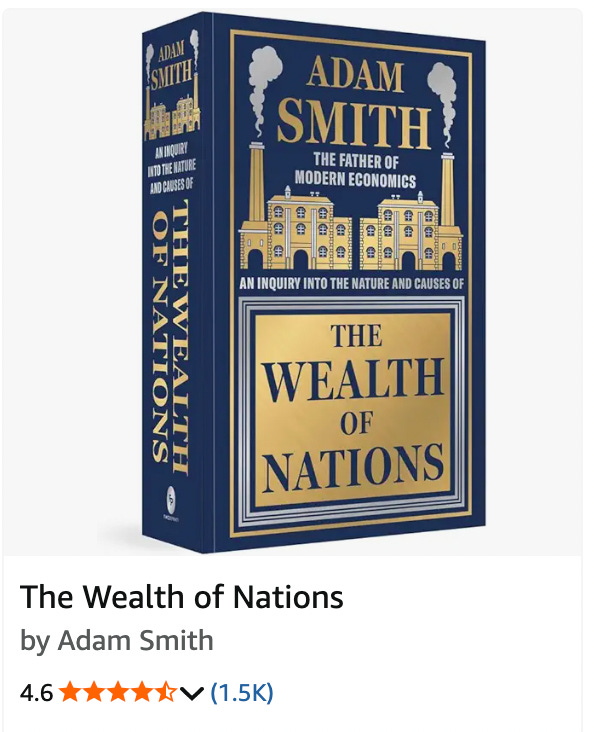
Why Use the “Invisible Hand” as a Case Study?
For more than two centuries now, Adam Smith’s little phrase—the “invisible hand”—has drifted through classrooms, boardrooms, and dinner-table debates. People repeat it with a kind of fond familiarity, almost as though it were an old family proverb everyone is expected to know by heart. It moves through our conversations quietly, without much reflection, like a saying whose meaning nobody has checked in years.
The philosopher John D. Bishop once asked a room full of business leaders what they believed the phrase meant. Most of them—well over sixty percent—said they thought the market could quietly correct itself, guided by some unseen force. They spoke of it the way one might speak of gravity—ever-present, steady, and trustworthy.
Today, the phrase is still offered as a gentle reassurance: that if each of us simply follows our own interests, the wider world will settle into harmony, much like water finding its level.
Over time, it has become a comforting shorthand—a symbolic way of suggesting that self-interest alone is enough to support the common good.
This small phrase has gathered many reactions along the way—sometimes admired, sometimes questioned. Even John Maynard Keynes observed how deeply it shaped the economic thinking of an entire century. And so, the “invisible hand” continues its quiet journey through our language, part history and part metaphor, appearing whenever we talk about how people and markets find their way through the world.
• Milton Friedman
In Why Government Is the Problem, Friedman opens by recalling:
“You remember Adam Smith’s famous law of the invisible hand: People who intend only to seek their own benefit are ‘led by an invisible hand to serve a public interest which was no part of their intention.’”
— Hoover Institution
• George Washington
In his First Inaugural Address, Washington invoked the idea in a more poetic form:
“No People can be bound to acknowledge and adore the invisible hand, which conducts the Affairs of men…”
— George Washington’s Mount Vernon
• Mitt Romney (U.S. Presidential Candidate)
During the 2012 campaign, Romney referenced the metaphor directly:
“I actually believe in the invisible hand! I think it’s the basis of capitalism.”
— Quartz
• Conservative / Reagan-Era Rhetoric
The “invisible hand” became a staple in conservative and free-market speeches. Commentators often note that Reagan’s economic vision rested on faith that the market’s unseen hand would guide private effort toward public good.
— Quartz
• Pierre Trudeau (Canada)
Trudeau pushed back against blind faith in market forces:
“As against the ‘invisible hand’ of Adam Smith, there has to be a visible hand of politicians whose objective is to have the kind of society that is caring and humane.”
— A-Z Quotes
A neat turn of phrase—acknowledging the mythic power of the market but insisting government must still play a guiding role.
• Boris Johnson (U.K.)
In a speech on the Internal Market Bill, Johnson invoked the metaphor in a lively, almost poetic way:
“…and allowed the invisible hand of the market to move Cornish pasties to Scotland, Scottish Beef to Wales, Welsh beef to England…”
— Gov.uk
He used it to argue for freer trade and economic integration across the U.K., especially after Brexit.
• Joseph Stiglitz (Economist and Public Figure)
A sharp critic of the metaphor’s overuse:
“The reason that the invisible hand often seems invisible is that it is often not there.”
— Wikiquote
• John Maynard Keynes
A notoriously skeptical figure toward laissez-faire, Keynes once admitted:
“I find myself more and more relying for a solution of our problems on the invisible hand which I tried to eject from economic thinking twenty years ago.”
— MaynardKeynes.org
Key Points
Over time, Smith’s phrase “the invisible hand” has evolved into a cultural shorthand—widely repeated, broadly trusted, and often assumed to describe a natural self-correcting force in markets.
Political leaders, economists, and public figures across eras have invoked the metaphor to support competing narratives: some treat it as evidence of market harmony, others as a myth that obscures the need for institutional guidance.
The phrase’s endurance reflects its symbolic power, not its precision; it has become a flexible signifier that people project their beliefs onto, allowing it to justify a wide range of economic and political claims.
Before the Myth — The Real Story of the “Invisible Hand”
A Metaphor Born of Faith, Not Finance
Very few people pause to wonder where the phrase truly began. Over the years, Adam Smith has received much of the credit—and sometimes the blame—but the story of the “invisible hand” reaches further back than most realize. And here is the quiet, pleasant surprise: the phrase did not begin with Smith at all. Long before he used it, the image had already passed through the hands of poets, preachers, and philosophers, each giving it their own shade of meaning as it made its gentle way through history
One of its earliest appearances comes from William Shakespeare’s Macbeth, where the doomed king calls on the night to hide his murderous intent:
Come, seeling night,
Scarf up the tender eye of pitiful day;
And with thy bloody and invisible hand
Cancel and tear to pieces that great bond
Which keeps me pale!
But the roots go back even further—over 2000 years—to an age when people saw every twist of fate as part of something divine. Long before Wall Street or modern economics, the “invisible hand” was a way to describe the quiet, unseen ways God was believed to shape the world—nudging events, turning hearts, and stitching chaos into order.
Thinkers and theologians across centuries used it to describe this mysterious guidance:
· Saint Augustine (354–430) wrote that “God’s hand is his power, which moves visible things by invisible means.”
· Nicolas Lenglet du Fresnoy (1735) spoke of an “invisible hand” that alone governs “what happens under our eyes.”
· Even in Genesis 41, the story of Joseph rising from prisoner to ruler of Egypt was seen as the work of that same unseen hand—misfortune transformed into destiny.
For centuries, the phrase belonged to the realm of faith, fate, and moral reflection—a way of describing how divine purpose could move through ordinary lives, even when people had no intention of serving it. It had nothing to do with markets or money; it was about mystery and meaning.
Adam Smith, ever the thoughtful moral philosopher, knew the roots of the phrase well. Many of those old books that first spoke of the “invisible hand” rested on his own shelves. So when he used it, his readers didn’t hear something new—they heard something familiar, something with soul.
They understood it as an old metaphor reborn: a gentle way of speaking about the unseen threads that guide our world—whether through Providence, through chance, or through the quiet harmony of human lives intertwined.
Key Points
The phrase “invisible hand” predates Adam Smith by centuries; it originated in religious and literary contexts, where it described divine or unseen moral guidance rather than market behavior.
Thinkers from Augustine to early modern theologians used the metaphor to capture the idea of hidden forces shaping events, and Smith’s contemporaries would have recognized it in this older, spiritual lineage.
Smith’s adoption of the phrase was therefore not an economic invention but a philosophical borrowing; its original function was moral and providential, not financial.
Footer Navigation:
👉 Next in the series: Part 3 —Understanding What Smith Meant → [link coming soon]
👉 Back to Part 1 — The Limits of Reason: Why Our Minds Reach for Metaphors → [link coming soon]
🌿 Series Navigation
Read all parts: [link to tag page]
Start from Part 1: [link coming soon]
Next post: [link coming soon]
Previous post: [link coming soon]