


Series Note:
👉 This post is Part 9: What Do We Do Next? (System-Level Solutions) (Part 9) for my 9-part series The Ethics of Economic Metaphors.
You can read all parts here → (link coming soon)
Solution — Looking at the System as a Whole
When we talk about how to fix the way politics works, it helps to step back and look at the entire system—almost like watching a river flow from the mountains to the sea. Along the way, there are bends, rocks, narrow passages, and wide openings. In the same way, our civic communication system shapes how ideas are shared, how policies are made, and how we choose the people who speak on our behalf.
Some people say, “Well, politicians use buzzwords and metaphors because they need to get elected.” And that is true. But perhaps that truth points to a deeper issue. Maybe the problem lies not in the people themselves, but in the pathway they must follow—the funnel that forces big ideas into tiny spaces, and careful thinking into catchy slogans.
Because people have limits. We all do. We can’t expect politicians to be perfectly rational any more than we expect it of ourselves. Instead, we should look at the systems around them—the rules they play under, the incentives they respond to, the way messages must be shaped, and the channels through which they speak. These systems invite certain types of leaders to step forward, shape the messages they use, and even color the decisions they make once in office.
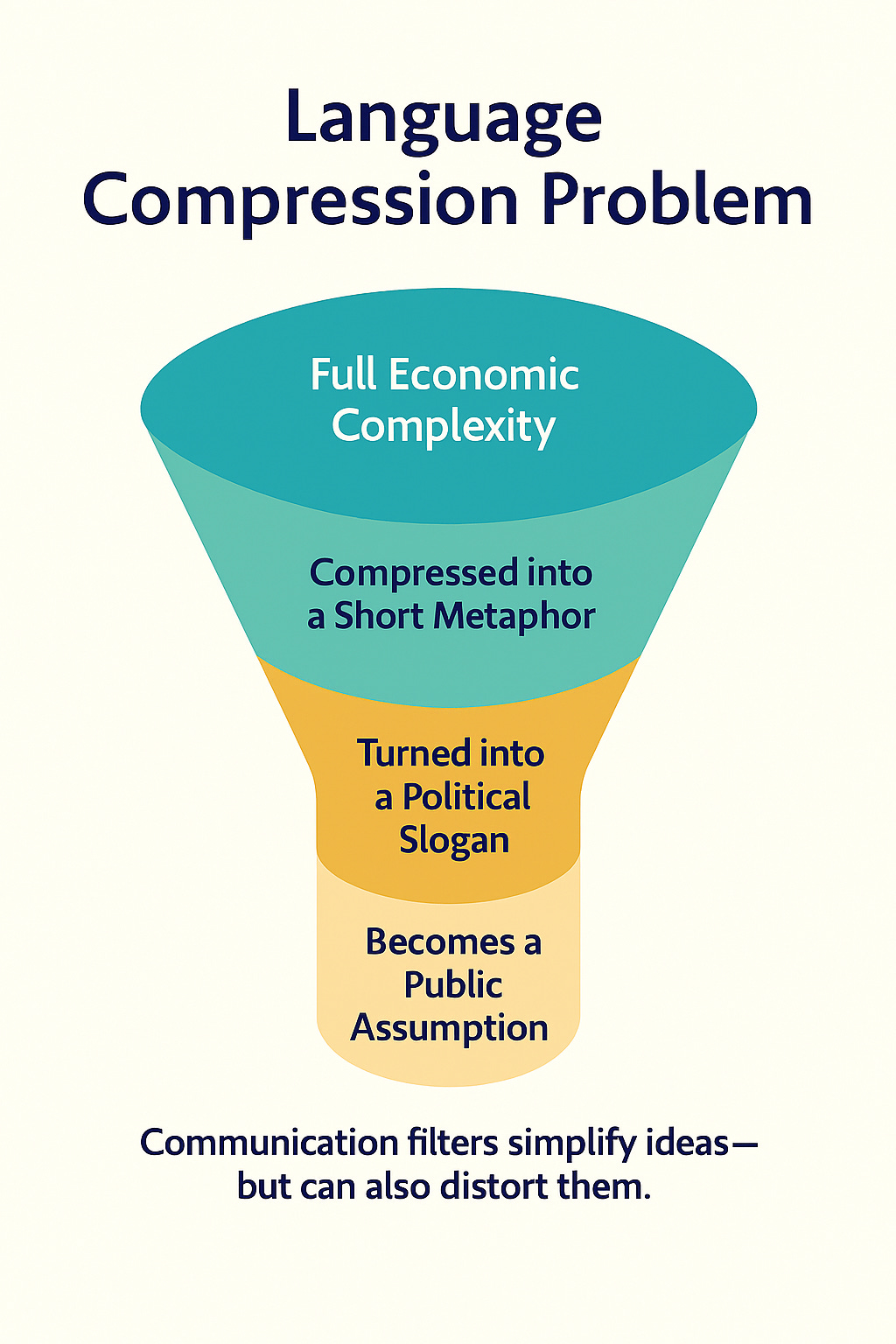
The problem is systemic, not personal.
Political speech is distorted less by the character of individual leaders and more by the communication structures they must operate within. Short-form media, campaign incentives, and compressed messaging function as systemic filters that reward simplicity over truth, thereby shaping who rises to leadership and how ideas are presented.
In truth, our political systems and communication networks act like a series of filters. They decide what kind of information reaches the public, what kinds of leaders rise, and what sorts of decisions get made—good, bad, or somewhere in-between.
Right now, the way we communicate in politics often discourages deep thought. Short messages, quick videos, and tiny sound bites reward catchy phrases instead of careful explanations. In a healthy democracy, citizens need full, honest information so they can make wise choices. That includes knowing the limits of the metaphors being used, and the boundaries of the ideas those metaphors are supposed to explain.
Television clips, TikTok videos, and short social media posts encourage thin thinking. They rush ideas along before their roots have time to settle. This isn’t necessarily a failure of people, but a limitation of the medium itself—a narrow channel that squeezes long thoughts into short spaces. And when a leader relies too heavily on these channels, it may be a quiet sign that they are not ready—or not willing—to explain their ideas with the care they deserve.
Podcasts, long-form interviews, and thoughtful essays allow something different. They give room for breathing, for unfolding, for gentle unpacking of complicated issues. They let a politician or policymaker explain where a metaphor works, where it stops working, and what they actually mean by the words they use.
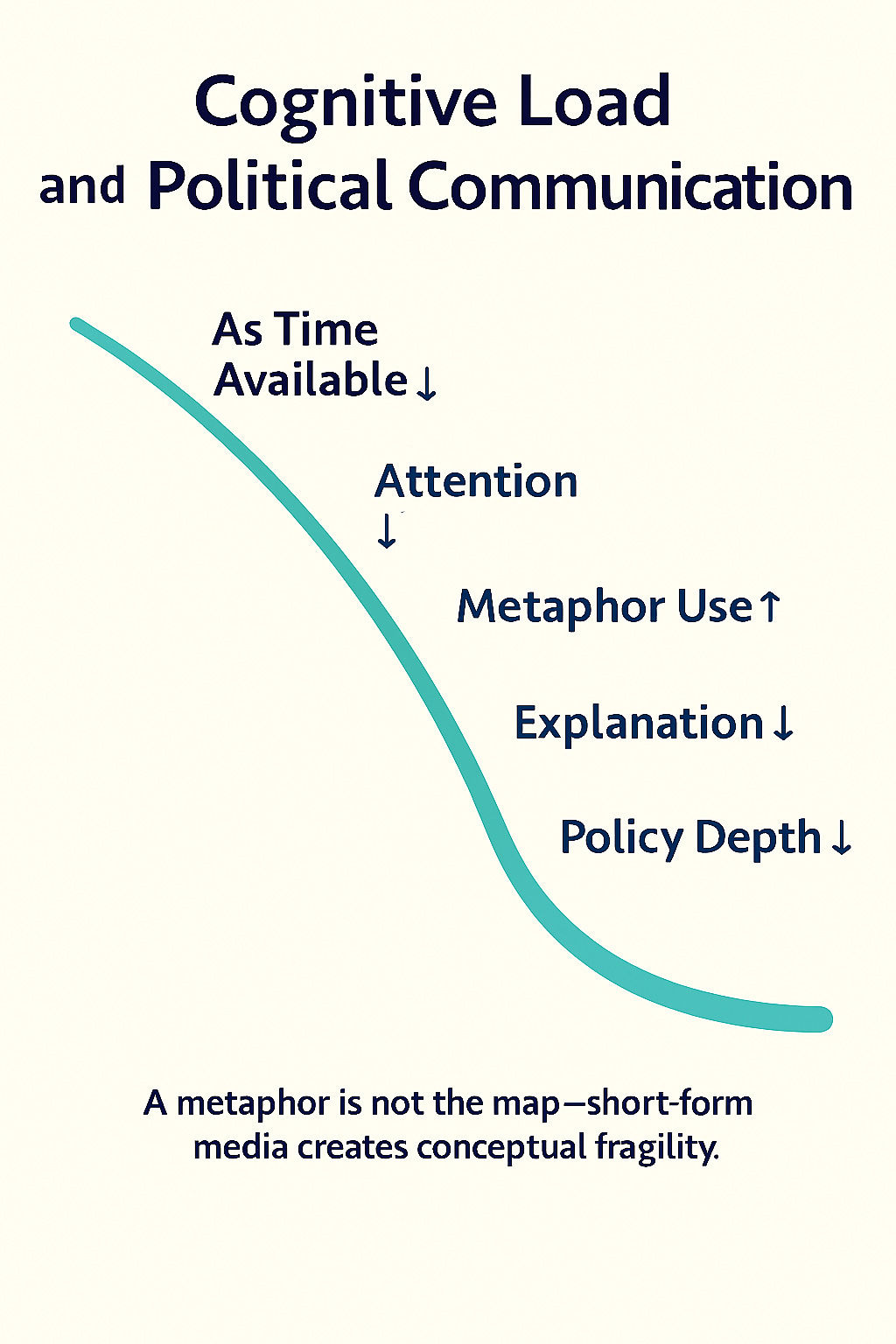
Modern communication channels constrain democratic understanding.
Platforms built for speed—television clips, social media, sound bites—truncate complex policy into metaphors and slogans, encouraging shallow cognition. These mediums limit the public’s access to full information and weaken citizens’ ability to evaluate the boundaries, assumptions, and ethical stakes of proposed policies.
As citizens, we should pay attention to which paths our leaders choose. If they rely only on short-form platforms, we should feel a mild, respectful sense of concern—not fear, not anger, but a wise curiosity. Do they truly understand the ideas they speak about? Do they know the limits of the words they use? Or are they relying on metaphors because they sound comforting and familiar?
Modern political communication often compresses ideas until they lose their shape. Metaphors become shortcuts, and shortcuts become habits. And when ideas get too small, they hide the important details—the assumptions, the limits, the responsibilities that lie beneath.
A thriving democracy needs more than facts; it needs context. It needs explanations that show not only what an idea is, but where it begins and where it ends. It needs leaders who do not treat citizens as passive listeners, but as partners who can understand complexity when it is shared with warmth and clarity.
The issue is not that our leaders lack intelligence or honesty. It is that our communication channels reward the quickest speaker, not the wisest one. Short-form media tends to reward shallow rhetoric. Long-form formats allow understanding, transparency, and accountability to grow like seeds in good soil.
So perhaps part of the solution is to build systems and norms that gently discourage the use of metaphors without explanation. To encourage leaders to speak plainly, carefully, and patiently. To create spaces where depth is valued over speed.
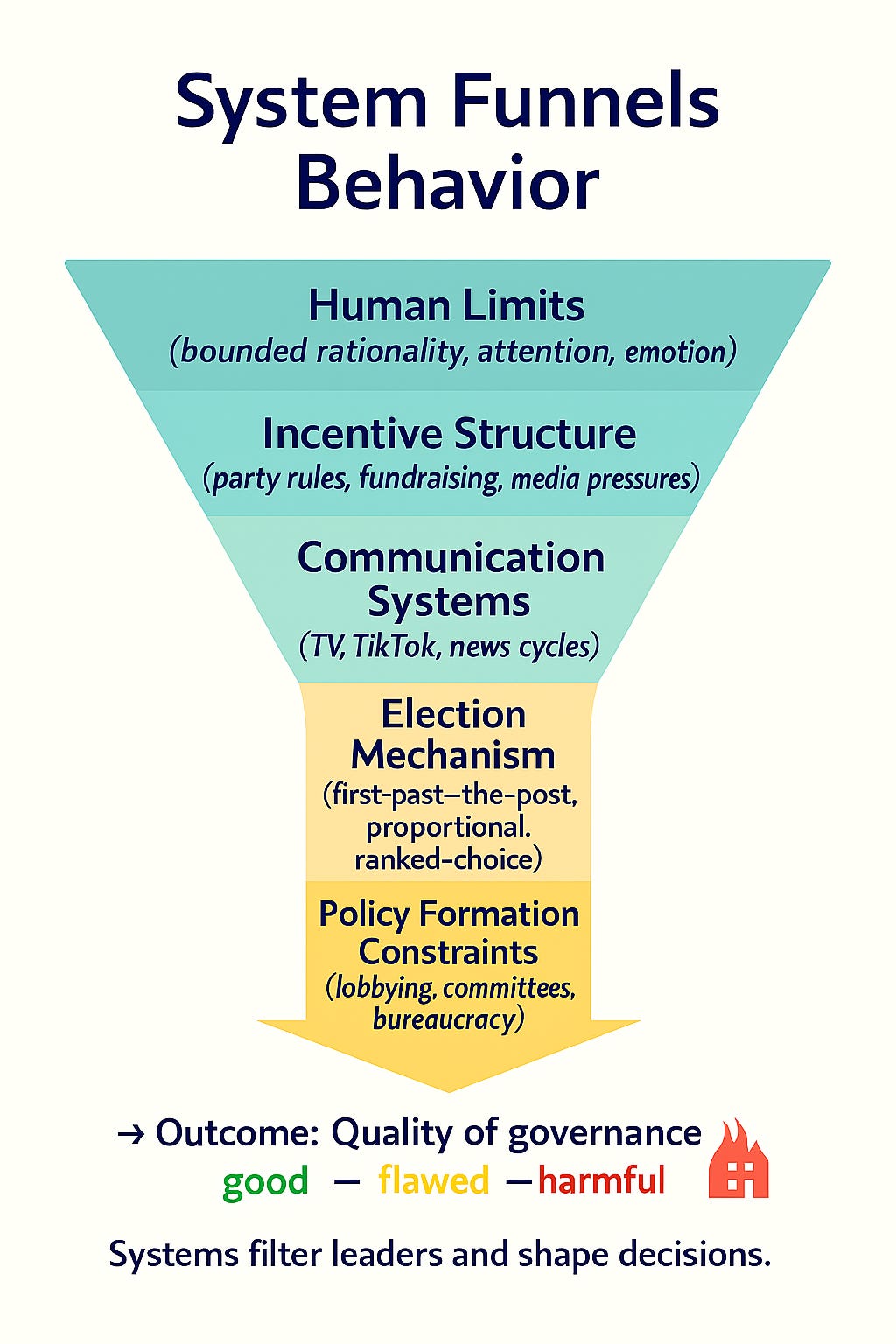
A healthy democracy requires depth, clarity, and explicit explanation.
To restore democratic integrity, political systems must create norms and structures that favor long-form reasoning: plain speech, transparent definitions, and the explicit articulation of a metaphor’s limits. Citizens are capable of understanding complexity when given space and honesty, and leaders have an ethical duty to provide that clarity.
This, I believe, is the ethical duty of anyone who serves the public:
to use words honestly, to explain them with care, and to trust citizens enough to offer clarity instead of charm.
When leaders speak with patience and truthfulness, and when citizens demand that level of honesty, our democracy becomes stronger—not because everyone agrees, but because everyone understands. And understanding, offered with kindness, is one of the greatest gifts we can give each other.
Key Points
The way politicians communicate is limited by the system. Short videos, quick ads, and tiny sound bites force big ideas into small spaces, which makes leaders use simple slogans instead of clear explanations.
Metaphors and catchy phrases get overused because fast media rewards speed, not careful thinking—so important details get lost, and citizens don’t get the full picture they need to make good decisions.
Democracy works better with slow, thoughtful communication. Long talks, interviews, and essays give space for leaders to explain ideas honestly, show where metaphors stop working, and treat citizens as real partners who can understand complex issues.

Innovations for a More Thoughtful Democracy
Building better systems to incentivize truth will ideally help us make wiser decisions.
Below are several innovations—some serious, some creative, all possible in a forward-thinking society.
None of them require a perfect world—only a world willing to experiment.
These are systems that gently encourage people to answer in concrete, literal terms—no slogans, no metaphors.
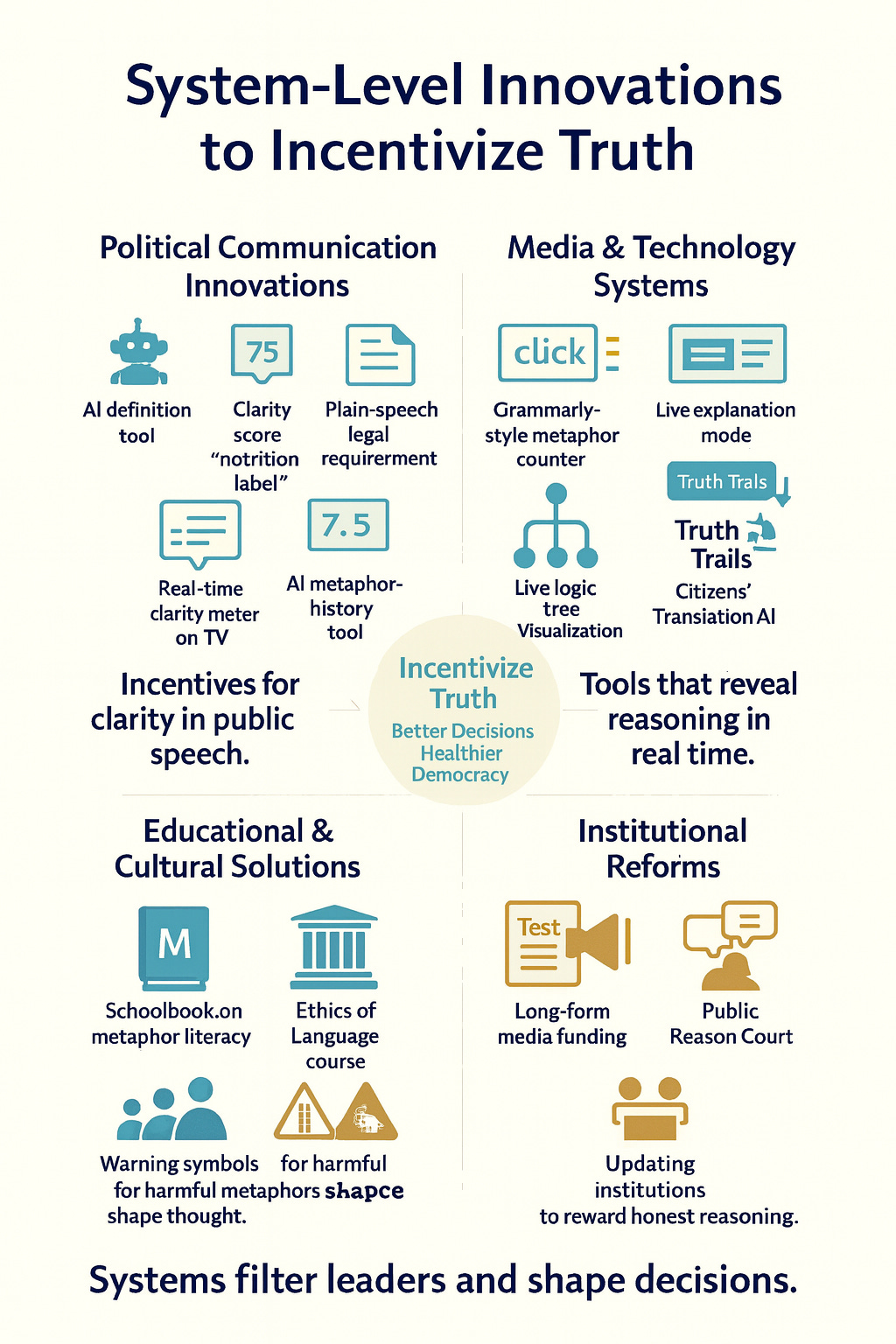
New “Outside the Box” System-Level Ideas
I. Political Communication Innovations (Systems + Incentives)
a. AI-required definitions for key terms
Before any bill or law can be tabled, an AI prompts:
“You used four metaphors and seven abstract terms. Please define each plainly in 2–3 sentences.”
No submission is accepted until the definitions are complete.
b. AI Clarity Score
AI systems score politicians on clarity, precision, and honesty.
Their scores appear publicly—like a nutritional label attached to every policy.
c. A “Plain Speech Requirement” for Laws
Every law must include a one-page, metaphor-free explanation.
(I expand on this in the next section.)
d. Metaphor Disclosure Footnotes
Whenever a metaphor appears in public communication, a footnote explains:
• its original meaning
• where it applies
• where it fails
This builds ethical transparency.
e. Real-time clarity scoring during TV interviews
A gentle on-screen display shows:
• Clarity Level
• Buzzword Count
• Metaphor Density
• Undefined Terms Flagged
Voters instantly see who speaks carefully and who speaks vaguely.
f. AI that parses truth + explains metaphor history
A companion tool for speeches or debates that says:
“This metaphor was first used by X in year Y. Here’s what it meant then, and how its meaning drifted.”
This anchors public speech in historical context and prevents metaphors from becoming misleading.
II. Media and Technology Systems
a. Grammarly-style “metaphor counter”
A writing assistant highlights metaphors and warns:
“This metaphor is carrying too much weight. Consider explaining its boundaries.”
b. “Deep Explanation Mode” on social platforms
Creators discussing politics must activate an extended mode that:
• lengthens explanations
• reduces reliance on buzzwords
• rewards clarity
c. Real-time “logic tree” visualizations
While a politician speaks, an AI draws a live diagram:
claims → evidence → assumptions → missing definitions.
This prevents hand-waving.
d. “Truth Trails” — expandable key terms in video
Click on any word in a political speech and a pop-up explains:
“Here’s the historical meaning, and here’s the common misunderstanding.”
e. A “Citizens’ Translation AI”
An AI that rewrites political speeches into plain language, gently revealing contradictions or unclear reasoning.
III. Educational and Cultural Solutions
a. A school curriculum on metaphor literacy
Like financial literacy, students learn:
• how metaphors shape thought
• how metaphors have misled citizens
• how to identify hidden assumptions
• famous metaphors that caused real-world harm, such as:
– “Pests” or “Vermin”
Used by authoritarian regimes to dehumanize opponents.
Once people are cast as a “plague,” extreme measures feel justified.
– “Motherland / Fatherland”
Leaders portray themselves as protectors of a parent-nation.
Sacrifice becomes a moral duty.
– “The Racial Ladder”
A hierarchy framed as natural and orderly.
“Moving up” requires accepting the ladder; questioning it becomes “disruption.”
– “The Nation as a Family”
Citizens become “children,” leaders the “father.”
Dissent becomes childish; obedience becomes maturity.
b. University requirement: “Ethics of Language”
A mandatory course teaching:
• responsible word use
• metaphor limits
• cognitive biases
• political-communication ethics
c. Public “Metaphor Clinics”
Libraries or community centers host workshops where citizens unpack common political metaphors and learn their boundaries.
IV. Institutional Reforms
a. Public Feedback Loop Reports
AI produces annual summaries showing how much metaphoric vs. literal language each politician used.
b. Long-Form Priority Funding
Governments fund platforms that prioritize long-form political content over short viral clips—essentially, a more engaging and substantive version of CPAC.
c. “Public Reason Courts” (lightweight, non-judicial)
Panels where citizens can challenge unclear political language, requiring politicians to clarify in simple terms.
Key Points
Make leaders speak clearly. New tools—like AI that counts metaphors, gives clarity scores, and asks leaders to explain their ideas in plain language—would stop politicians from hiding behind vague or confusing words.
Use technology to show the truth. Apps, videos, and tools could highlight unclear thinking, show missing definitions, and turn speeches into simple explanations so everyone understands what’s really being said.
Teach people how words work. Schools, universities, and communities can help everyone learn how metaphors shape thinking, so citizens can spot when language is being used honestly—or used to mislead.

A Seed of an Idea Expanded
A small experiment in system innovation—offered with humility, curiosity, and hope.
Here’s one idea I’ve taken the time to sketch out a little more fully. Parts of it can be trimmed, adapted, or tossed aside altogether. And if the whole thing turns out not to be useful, that’s perfectly fine—I won’t take it to heart.
This is simply a bit of friendly brainstorming, offered in the hope that it might spark something in the minds of people who work in technology and care about strengthening our democracy. If it inspires even one good step forward, then it has already done its job.
This tool is the modern moral gardener. It keeps the democratic soil healthy. It trims back confusion and lets clarity grow. It treats citizens as adults—capable, thoughtful, deserving of honest information. A gentle structure that guides understanding toward truth.
The “Instant Law Summary” Plug-In
A universal, one-click gateway into the one-page Plain Speech Requirement for every law.
The Core Idea
Whenever a politician, lawmaker, or commentator mentions a bill—on TV, in a debate, on YouTube, in Parliament, or in public hearings—a small clickable icon appears beside the name of the law.
Click once, and it opens a simple one-page, Grade-6-level summary (the Plain Speech Requirement).
This page acts as the universal abstract for every law, giving all citizens the same grounding—instantly, equally, and without spin.
Why It Exists
Most citizens:
join a debate halfway through
haven’t followed the background of the bill
don’t understand jargon
don’t have time to watch hours of discussion
don’t want political spin or patronizing explanations
Democracy does not fail because people lack intelligence.
It fails when people lack clean, accessible information.
A one-click summary fixes this—not by simplifying the issues, but by clearing the fog around them.
What Appears on Screen
Whenever the bill is mentioned (“Bill C-41,” “The Clean Energy Act,” etc.), a small indicator appears:
🔵 View Summary
or a small ℹ️ icon
or a subtle underline signaling “click for details”
Different platforms display it differently:
Television: a small QR code
Phones / Computers: a direct hyperlink
Live Debates: a tiny on-screen card
What the Citizen Sees When They Click
They are taken directly to:
The One-Page Plain Speech Requirement for Laws
1. What This Law Does — in One Sentence
A short, direct description with no jargon.
2. Why We Need This Law
What problem it solves
What harm occurs if we do nothing
Who is affected today
3. What Exists Today
Current rules or gaps
Evidence the status quo is failing
4. What This Law Changes
Clear list of new rules
Who must act differently
When changes begin
5. Expected Benefits (Intended Consequences)
Main goals
Who benefits
Simple metrics for success
6. Possible Unintended Consequences
Primary: most likely side effects
Secondary: long-term or ripple effects
7. Cost & Funding
Projected cost
How it will be paid for
What happens if costs rise
8. Oversight & Sunset Clause
Who monitors results
Review timeline
When it expires if it fails
9. What Happens If We Reject It
Clear consequences of not passing the bill.
10. Key Terms (Defined Clearly)
Every technical term explained as if to a 12-year-old.
Metaphor-free, plain language, citizens-first.
11. Who Is Sponsoring the Law
Transparency and accountability:
Name(s)
Political party
Relevant background
Any personal, regional, or economic ties
12. Who Supports the Law — and Why
Politicians, public groups, unions, associations
Simple explanations of their reasoning
13. Who Opposes the Law — and Why
Names of opponents
Their concerns
Any evidence they provide
Why This Is Transformative
Because it removes:
confusion
jargon
political spin
cognitive overload
misinformation
paternalism
“trust us” politics
And it restores:
clarity
transparency
intellectual honesty
informed consent
democratic equality
No citizen is ever “behind.”
Everyone can join the conversation—instantly, confidently, and on equal footing.
Further
This system:
Levels the playing field between experts and ordinary citizens
Removes the advantage created by insider language
Reduces manipulation caused by metaphors, framing, and selective omissions
Makes debates fairer because everyone starts from the same facts
Builds trust between citizens and institutions
Strengthens democracy by making informed judgment possible
Cuts through noise in a media environment designed for distraction
Protects vulnerable voters from misinformation
Shifts incentives—politicians must speak clearly or lose credibility instantly
Creates accountability through transparent definitions and plain speech
Supports journalists by giving them a clean baseline to reference
Improves public reasoning by encouraging concrete, literal explanations
Key Points
Equal access to information is a precondition for judgment.
Citizens cannot evaluate laws if they lack clear, timely, comprehensible explanations.
This turns legislative knowledge from an expert privilege into a shared foundation.Transparent design counteracts the distortions of modern political communication.
Fragmented media hides context.
Embedding instant summaries restores continuity, reduces cognitive overload, and neutralizes jargon and spin.
And with all of this gathered, we can end where all good journeys end—with a clear, honest call for thoughtful conversation.
👉 Next in the series: Conclusion → (link coming soon)
👉 Back to What Do We Do Next? (Individual Level) Part 8
→ (link coming soon)
🌿 Series Navigation
Read all parts: (link coming soon)
Start from Part 1: (link coming soon)
Next post: (link coming soon)
Previous post: (link coming soon)