


Series Note:
👉 This post is Part 3: Understanding What Smith Meant for my series The Ethics of Economic Metaphors.
You can read all parts here → (link coming soon)
“Disposition to admire, and almost to worship, the rich and the powerful...[is] the great and almost universal cause of the corruption of our moral sentiments.” –The last thing Adam Smith wrote, months before he died in 1790 (Revision to Moral Sentiments, Ch. 1, Section II).
Understanding Smith’s Own Words
Beginning Where He Begins
Before we let the world’s interpretations sweep us along, it is only fair—and only honest—to start with what Adam Smith actually wrote. In The Wealth of Nations, the famous phrase appears only once, tucked quietly into a single passage. Not a grand proclamation. Not a sweeping principle. Just a small observation about merchants who preferred to keep their money close to home rather than risk it abroad:
“By preferring the support of domestic to that of foreign industry, he intends only his own security;
and by directing that industry in such a manner as its produce may be of the greatest value, he intends only his own gain,
and he is in this, as in many other cases, led by an invisible hand to promote an end which was not part of his intention.”
— The Wealth of Nations, Book IV, Chapter II
A single sentence. A simple point. And yet, over two centuries later, these few quiet words would grow into one of the most repeated metaphors in economic thought.
To understand it, we must step back into the world Smith was actually seeing.
The World That Shaped Smith
Trade Winds, New Roads, and A Nation in Motion
By the time Adam Smith began writing, Britain was already humming with activity. Trade was no longer a novelty—it was a rhythm woven into daily life. Since the 14th century, English merchants had looked beyond their shores, their ships catching global winds that carried wool, gold, spices, and fine cloth across oceans.
Britain, being an island, lived by its commerce the way a farmer lives by his fields.
And the numbers tell a remarkable story. Between 1700 and 1770, foreign markets for English goods grew at a pace that startled even seasoned merchants. Exports expanded ten times faster than domestic demand. Between 1700 and 1750, local industries grew only 7 percent, but exports leapt 76 percent. The next two decades showed the same pattern: home markets rose another modest 7 percent, while exports soared nearly 80 percent (Hunt & Lautzenheiser, 41).
This hunger for foreign trade helped spark the Industrial Revolution. Ships moved faster. Roads and canals spread across the countryside like veins. Human distance shrank. The world was drawing closer, and the British merchant stood right at the center of it (Chomsky, 1993).
Adam Smith watched all of this—not from a distant perch, but as a keen observer of how people behaved when opportunity knocked. He saw English merchants sending their capital abroad in search of higher returns and worried about what such outward movement meant for the strength of the nation.
So when Smith used the “invisible hand,” he wasn’t preaching laissez-faire. He was offering a gentle nudge:
remember that prosperity often begins by tending the soil close to home.
To understand why he gave this nudge, we must look at what he was pushing back against.

Smith the Quiet Rebel
His Long Struggle Against Mercantilism
In Smith’s lifetime, the dominant system was mercantilism—a worldview that saw trade as a battle and wealth as something to be hoarded. Wealth meant gold and silver. Power meant exporting more than you imported. Rival nations were to be kept weak, and strong nations were meant to guard their privileges through tariffs, monopolies, and colonial control.
It was a world suspicious of openness and nervous about competition.
Smith found all of this deeply misguided. Mercantilism, he believed, turned nations into jealous neighbors, each guarding its own treasure chest. He felt it strangled creativity and sowed distrust. For him, true prosperity came not from hoarded metals but from a healthy circulation of goods, ideas, and human energies.
Mercantile policies, he warned, rewarded inefficiency. They protected industries not because they were good, but because they were sheltered. And ordinary people—workers, families, the poor—paid the highest price, trapped by high prices and limited choices.
Smith’s fight against mercantilism was not the fight of an ideologue but of a man who believed justice, fairness, and community mattered. He wanted a world where competition made goods cheaper and work more dignified. Where nations traded in partnership, not rivalry. Where a shopkeeper’s ambition did not depend on a king’s permission.
The Real Meaning Behind the Metaphor
A Small Insight, Not a Universal Law
When we place Smith’s “invisible hand” back into its proper context—in time, place, and purpose—its meaning becomes both clearer and gentler. Smith was not unveiling a grand theory of capitalism. Nor was he declaring that human self-interest magically creates harmony.
He was describing a modest pattern:
Some merchants, choosing safety and familiarity, invested their money at home. In doing so, they happened—quite unintentionally—to strengthen the local economy. Their self-interest lined up, just this once, with the public good.
That is all Smith claimed.
No more, no less.
When merchants kept their money in Britain, they funded local industries, supported workers, and fortified the nation’s ability to withstand economic storms. Their caution became a quiet strength. And in this limited moment, Smith said they were “led by an invisible hand” to promote a good they did not intend.
But that gentle alignment was never offered as a universal rule. Smith was not saying self-interest always leads to good outcomes. He was not saying markets correct themselves like nature obeys gravity. He was not saying greed is noble.
He was making a simple observation:
Sometimes, when people stay close to home, the good they do nearby ripples outward in surprising ways.
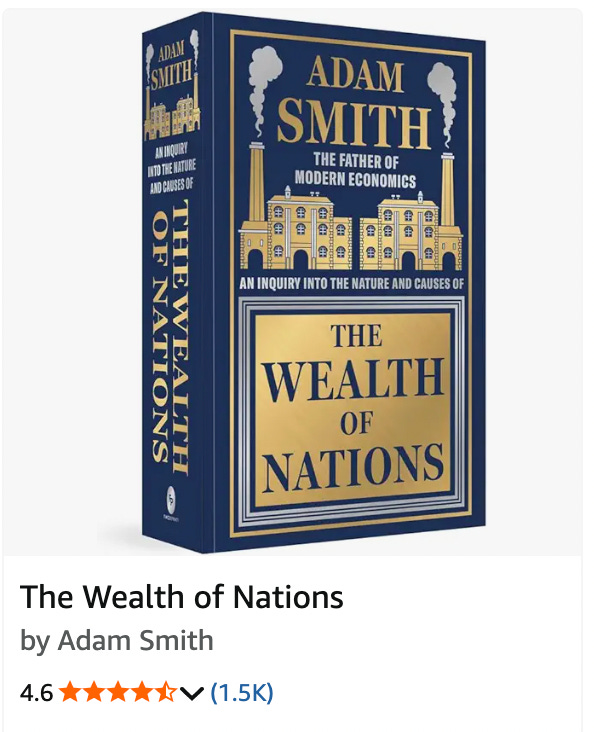
Smith on Self-Interest
A Spark—Not a Steering Wheel
Smith understood people well. He knew that most of us work hardest when our own livelihood is involved. He wrote:
“It is not from the benevolence of the butcher, the brewer, or the baker that we expect our dinner,
but from their regard to their own interest.”
— Book I, Chapter 2
Yet this insight is often lifted from its surrounding pages and treated like a stand-alone philosophy. Smith never claimed that self-interest alone brings about the common good. For him, it was simply the spark that keeps economic life moving—not the steering wheel that guides society.
He saw clearly the danger in unleashing ambition without guardrails. He worried about merchants who manipulated laws, cornered markets, or misled the public for profit.
His caution is unmistakably firm:
“The proposal of any new law or regulation of commerce
which comes from this order [those who live by profit]
ought always to be listened to with great precaution.”
— Book I, Chapter 4
Smith understood that power can bend policy. Wealth can distort justice. And markets, left completely to themselves, can drift away from fairness.
He believed that freedom was essential—but never sufficient.
Government’s Role: A Thoughtful Partner
Never a Bystander
In the centuries after Smith, many people used his name to argue for hands-off government. But this reading sits strangely beside the text itself. Smith repeatedly insisted that certain responsibilities belonged squarely to the state.
He wrote that government had duties that markets could not fulfill—not because markets were flawed, but because some tasks simply needed collective action.
Smith supported, among other things:
· National defense and trade protection:
Smith supported the Navigation Acts of 1660, which gave Britain a monopoly in colonial trade—an explicit break from free trade ideals. He justified it with the line: “Defense, however, is of much more importance than opulence.” (WN Book IV, ch. 2)
· Public education:
He argued that government should provide village schools and shape the curriculum to prevent ignorance and moral decay among the working classes. (WN Book V, ch. 1)
· Regulation of finance:
Smith endorsed usury laws—limits on interest rates—to protect naïve or reckless investors from their own “stupidity.” (WN Book I, ch. 9)
· Public works and infrastructure:
Smith called for the state to fund and maintain roads, bridges, canals, and harbors—projects “too expensive for private individuals” but essential to national prosperity. (WN Book V, ch. 1)
· Justice and property rights:
He viewed the administration of justice as a core government duty—without it, no market could function. (WN Book V, ch. 1)
· Public health and safety:
Smith even supported certain regulations on dangerous trades to protect workers’ health and prevent exploitation. (WN Book V, ch. 1)
Smith, in other words, believed in markets within a moral framework—a structure upheld by justice, wisdom, and a sense of shared duty.
Smith’s Balanced Vision
Freedom With a Conscience
To Smith, the “invisible hand” worked only under certain conditions—when guided by justice, when anchored in moral restraint, and when supported by social trust. Without these, self-interest could sour. Ambition could harden. And markets could drift toward monopoly, exploitation, or neglect of the common good.
He understood the danger in admiring wealth simply because it is wealth.
He warned of the human tendency to “admire and worship the rich and the powerful,” even when they do not serve the public well.
Prosperity, for Smith, was not measured by how much wealth gathered in a few hands, but by how trade uplifted the broad community. When money fled abroad chasing higher returns—leaving families behind—it weakened the nation. When power bent policy in its favor, it led society astray.
The “invisible hand,” in Smith’s own quiet voice, was not a license for greed.
It was a reminder that private interest supports the common good only when held within a moral frame.
What Smith Actually Offered
So the “invisible hand” was not a mystical force nor a grand doctrine. It was closer to a gentle tug of loyalty—what economists today might call “home bias.” In a world where British capital was flowing outward, Smith was encouraging readers to notice the quiet strength of tending one’s own community.
My aim here is simply to clear the fog around this moment. Smith was not building a universal law. He was noticing a modest pattern: when merchants invested close to home, their choices—not by design but by proximity—helped strengthen the society around them.
Here is the quieter truth:
Smith used the phrase only once, and in a very particular context.
It was not a hymn to unbounded self-interest.
It was a reminder that loyalty, familiarity, and community ties have economic power.
In Smith’s eyes, prosperity often begins at our own feet—working where we can see the faces affected by our choices, and remembering that the good we do close to home often grows into something larger than we ever intended.
Key Points
Adam Smith used the “invisible hand” only once, and he meant something simple: when merchants keep their money close to home, it can sometimes help the community without them trying.
People later changed his idea, turning it into a big rule that markets always work perfectly by themselves—but that isn’t what Smith believed.
Smith supported both freedom and fair rules, because he knew self-interest can help society only when it is guided by honesty, justice, and good government.
Footer Navigation:
👉 Next in the series: Lost in Translation (Part 4): How Smith’s quiet observation grew into a global doctrine. → (link coming soon)
👉 Back to Part 2 — The History of the Invisible Hand (Part 2)How a small phrase started in faith, wandered into economics, and became a symbol far larger than Smith ever intended. → (link coming soon)
🌿 Series Navigation
Read all parts: (link coming soon)
Start from Part 1: (link coming soon)
Next post: (link coming soon)
Previous post: (link coming soon)